

2026
A switchable-transparency eutectogel enabled by multiple dynamic interactions for smart display applications
Eutectogels constitute a new class of soft materials, integrating the most desirable characteristics of traditional gels and offering broad versatility across numerous applications. However, the development of thermo-responsive eutectogels, particularly those capable of thermally switchable transparency, remains highly challenging. In this study, a smart thermo-responsive eutectogel (STE) is fabricated using an N-isopropylacrylamide/metal salt-based deep eutectic solvent. Leveraging multiple hydrogenbonding and coordination interactions, the STE displays excellent mechanical properties, achieving a tensile strength of 2.7 MPa.

Journal of Materials Chemistry A (2026)
2025
A Universal Interfacial Strategy Imparting Hydrophobicity to Hydrophilic Eutectogels for Robust Adaptation to Extreme Aqueous Environments
Eutectogels and DES-based elastomers offer ecofriendly, cost-effective solutions for wearable devices but face limitations in underwater applications due to their high hygroscopicity. In this study, we present a strategy for developing a core−shell elastomer (CSE) based on deep eutectic solvents (DESs) that remains stable and functions effectively underwater. The hydrophobic shell (HS) is composed of a natural DES of thymol and camphor, while the printable conductive core (CC) is based on a polymerizable DES of acrylic acid and choline chloride.

Chemistry of Materials (2025)
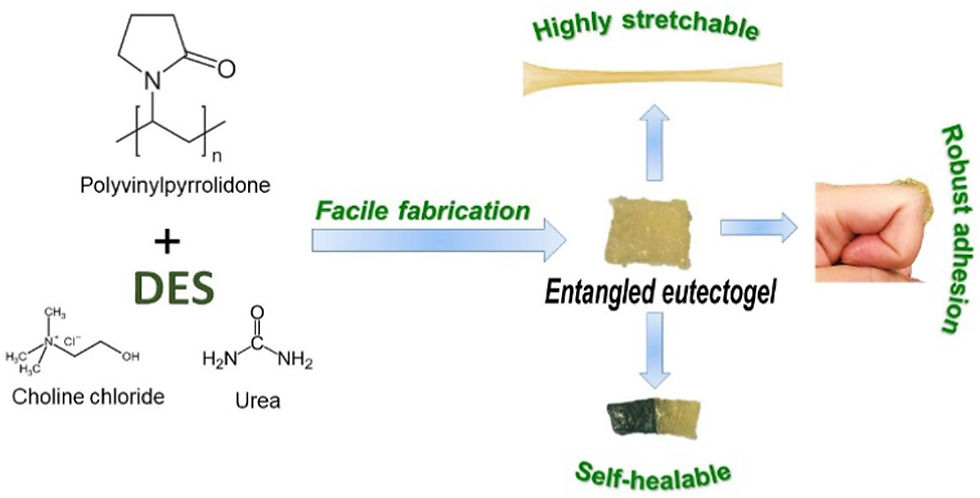
A functional eutectogel based on ultrahigh–molecular weight polymers: Physical entanglements in deep eutectic solvent
Eutectogels have emerged as a promising material for wearable devices due to its superior ionic conductivity, non-volatility, and low cost. Despite numerous efforts, only a limited number of polymers and gelling mechanisms have been successfully employed in the fabrication of eutectogels. In this study, an effective three-dimensional network is developed based on the entanglements of polymer chains, facilitating the formation of an entangled eutectogel. The fabrication process involves directly dissolving ultra-high molecular weight polyvinylpyrrolidone (PVP) in deep eutectic solvent (reline) through a simple heating–cooling method.
Journal of Colloid and Interface Science (2025)
Exploring Enzyme Encapsulation Efficiency in MOFs Using Eco-Friendly Approaches
The encapsulation of protein enzymes in metal-organic frameworks (MOFs) has been recognized as an effective enzyme immobilization approach. In this study, we demonstrated the influence of enzyme amount and the isoelectric points (pI) of different enzymes on the enzyme loading capacity in both mechanochemical (ball-milling) and water-based approaches. This study highlights the crucial role of enzyme properties in the encapsulation process within MOFs, providing valuable insights for fabricating enzyme-MOF biocomposites for diverse applications, such as protein drug delivery.

ChemSusChem (2025)
2024
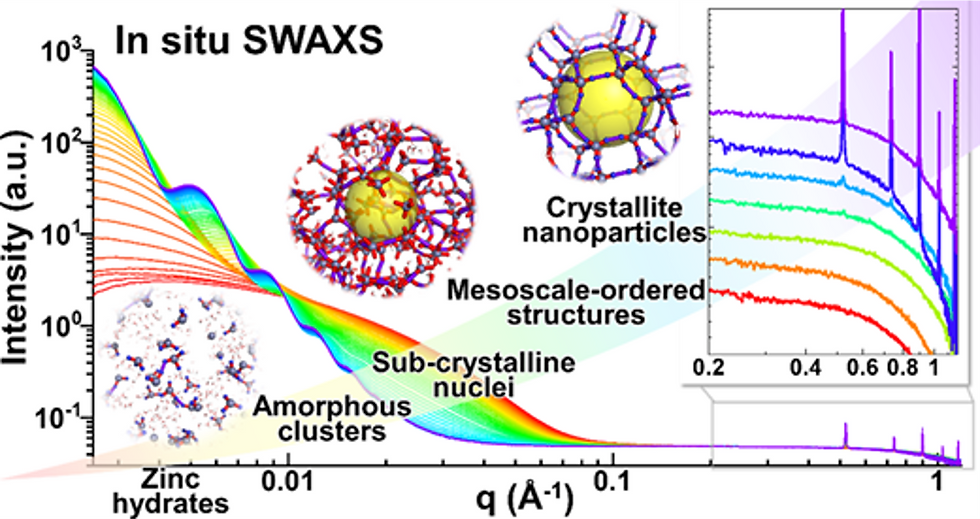
Decoding the Biomimetic Mineralization of Metal−Organic Frameworks in Water
This study unveils the “green” metal−organic framework (MOF) structuring mechanism by decoding proton transfer in water during ZIF-8 synthesis. Combining in situ small- to wide-angle X-ray scattering, multiscale simulations, and quantum calculations, we reveal that the ZIF-8 early-stage nucleation and crystallization process in aqueous solution unfolds in three distinct stages. Beyond these core advancements, we explore the influence of encapsulated pepsin and nonencapsulated lysozyme on ZIF-8 formation, finding that their amino acid proton transfer capacity and concentration influence the resulting biomolecule-MOF composite’s shape and encapsulation efficiency.
ACS nano (2024)
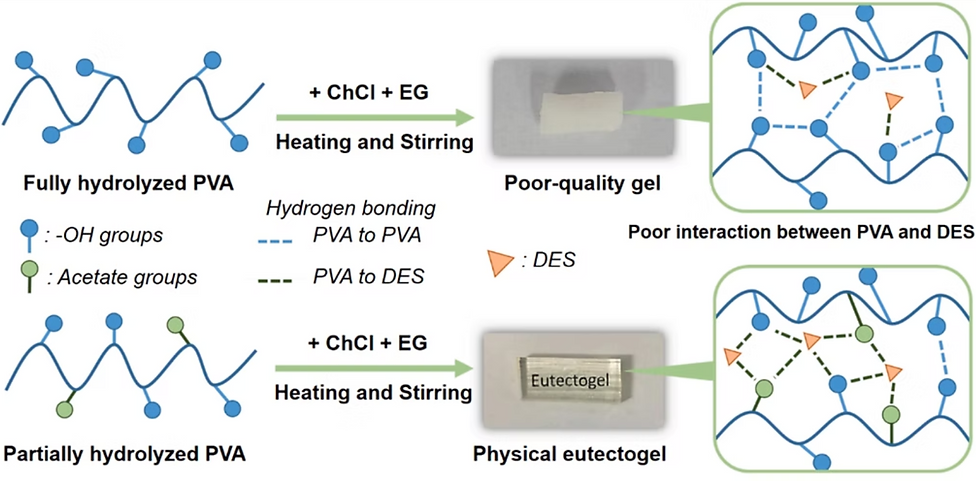
One-step, additive-free fabrication of highly stretchable and ultra-tough physical polyvinyl alcohol-based eutectogels for strain sensors
Polyvinyl alcohol (PVA)-based eutectogels are appealing due to their non-volatility, low cost, and superior mechanical properties. However, enhancing their compatibility with deep eutectic solvent (DES) often necessitates complex procedures and the use of hazardous substances. In this work, a highly stretchable and ultra-tough physical eutectogel is fabricated in a single step using partially hydrolyzed PVA. The presence of hydrophobic acetate groups in the PVA disrupts hydrogen bonding among PVA chains, while simultaneously enhancing hydrogen bonding between PVA and DES.
Chemical Engineering Journal (2024)
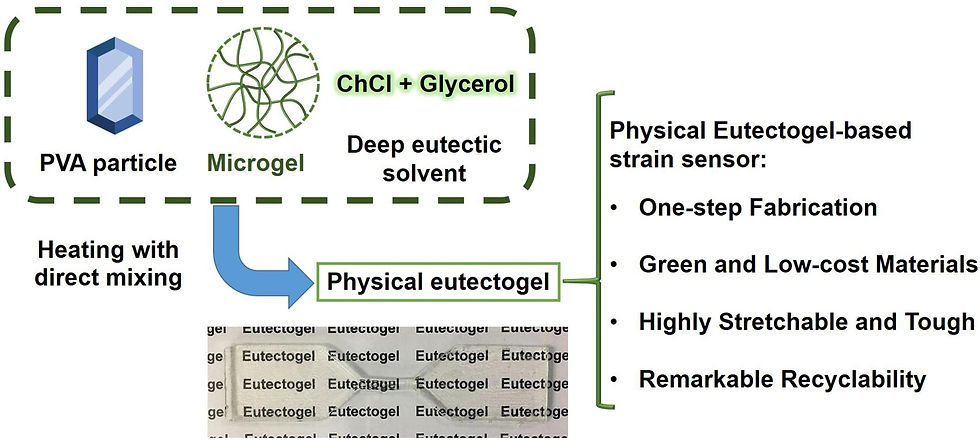
One-step Fabrication of Physical Eutectogel with Recyclability: Crystalline Domain Regulation Induced by Microgels
Despite their non-volatility, low cost, and recyclability, physical eutectogels’ appeal is hindered by the intricate fabrication process and the involvement of hazardous chemicals. The network of polyvinyl alcohol (PVA) in deep eutectic solvent (choline chloride and glycerol) might be developed by the addition of microgels of polyacrylic acid (Carbopol).
Journal of Colloid and Interface Science (20240
2023
A green and ultrafast one-pot mechanochemical approach for efficient biocatalyst encapsulation in MOFs: insights from experiments and computation
In this study, we illustrated the enzyme one-pot mechanical encapsulation within zeolitic imidazolate framework-90 (ZIF-90), a MOF subfamily. A substantial yield (ca. 80%) was achieved in only 10 s at 8 Hz or lower frequencies, assisted by a small amount (∼100 ml) of Tris buffer solution. The encapsulated enzyme catalase (CAT), responsible for decomposing hydrogen peroxide, maintains its bioactivity after mechanical treatment.

Journal of Materials Chemistry A (2023)
Controlled Encapsulation of Gold Nanoparticles into Zr-Metal−Organic Frameworks with Improved Detection Limitation of Volatile Organic Compounds via Surface-Enhanced RamanScattering
Volatile organic compounds (VOCs) have harmful effects on human health and the environment but detecting low levels of VOCs is challenging due to a lack of reliable biomarkers. However, incorporating gold nanoparticles (Au NPs) into metal−
organic frameworks (MOFs) shows promise for VOC detection. In this study, we developed nanoscale Au@UiO-66 that exhibited surface-enhanced Raman scattering (SERS) activity even at very low levels of toluene vapors (down to 1.0 ppm) due to the thickness of the shell and strong π−π interactions between benzenyl-type linkers and toluene.
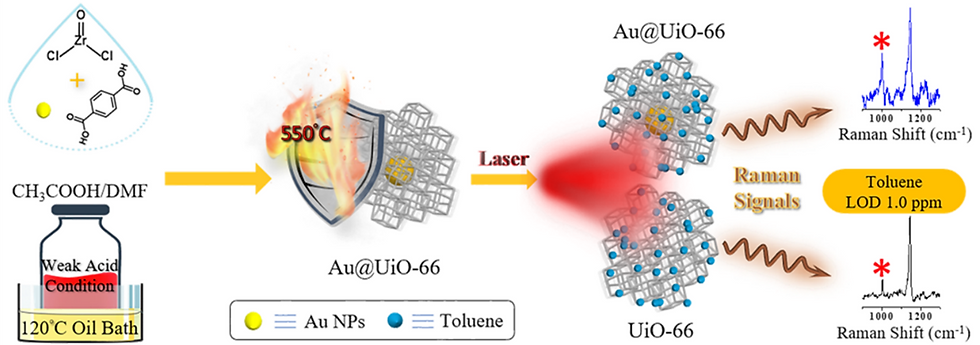
Inorganic Chemistry (2023)
Jammed Microgels in Deep Eutectic Solvents as a Green and Low Cost Ink for 3D Printing of Reliable Auxetic Strain Sensors
Additive manufacturing is a promising technique for offering novel functionality to various materials by creating three-dimensional (3D) structures. In this work, a simple two-step mixing approach is developed to prepare a 3D printing ink from green, low-cost, and low-toxicity materials [commercial Carbopol and deep eutectic solvents (DESs)]. A small weight fraction of Carbopol can impart desired rheological properties to the DES used in the 3D printing ink and also can significantly enhance the stretchability of eutectogels up to 2500% strain.
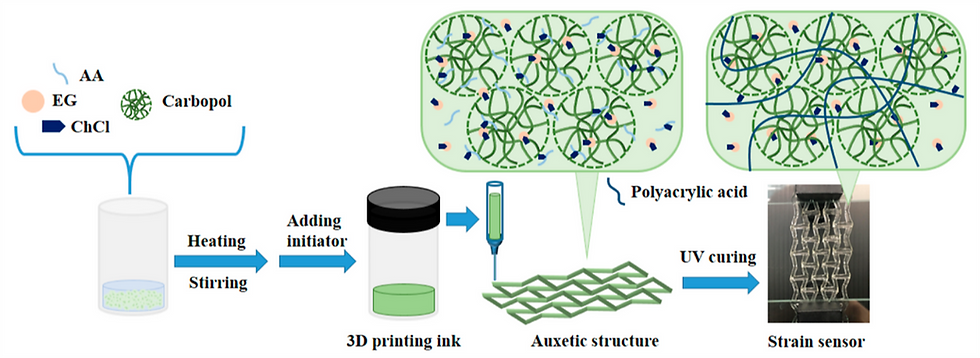
ACS Applied Materials & Interfaces (2023)
2022 and before
-
Šutka, A. *; Shieh, F.-K. *; Kinka, M.; Lapčinskis, L.; Chang, C.-C.; Lam, P. K.; Pudzs, K.; Verners, O., Triboelectric behaviour of selected MOFs in contact with metals. RSC Advances 2022, 13 (1), 41-46.
-
Vo, T. H.; Lam, P. K.; Sheng, Y.-J. *; Tsao, H.-K. *, Amphibious superamphiphilic polystyrene monolith with underwater superoleophilicity: Capture of underwater oil. Applied Surface Science 2021, 570, 151142. (co-first author)
-
Hsu, P.-H.; Chang, C.-C.; Wang, T.-H.; Lam, P. K.; Wei, M.-Y.; Chen, C.-T.; Chen, C.-Y.; Chou, L.-Y. *; Shieh, F.-K. *, Rapid Fabrication of Biocomposites by Encapsulating Enzymes into Zn-MOF-74 via a Mild Water-Based Approach. ACS Applied Materials & Interfaces 2021, 13 (44), 52014-52022.